
NEWS
2026-04-07
Against the backdrop of continuous advancements in in-vehicle monitoring and intelligent systems, solutions relying solely on Visual AI Perception are no longer sufficient to meet the demands of complex applications. This is particularly evident in scenarios such as mines, construction sites, ports, and logistics transportation, where dynamic environments and challenging operating conditions place higher requirements on system stability and reliability.
As a key component of the intelligent front-end system, STONKAM has further introduced Non-visual AI Perception alongside Visual AI Perception. It can be deployed independently or in combination with Visual AI Perception cameras, leveraging multi-sensor fusion to build a more robust environmental perception capability.
Non-visual AI Perception cameras acquire environmental information through non-visual data. Core products include Radar-Vision Integrated Units, LiDAR, Thermal Cameras, Millimeter Wave Radars, and Ultrasonic Detectors.
This approach does not rely on image data, but instead utilizes information such as distance, temperature, and reflected signals to enable reliable object detection, significantly enhancing system adaptability in complex environments.
With Visual AI Perception cameras, systems can intuitively capture surrounding visual information. However, in practice, Visual AI Perception is not suitable for all scenarios and still faces limitations under certain conditions:
● Night / Rain / Fog / Strong light: Poor lighting or harsh weather reduces image clarity and affects recognition accuracy.
● Obstruction / Dust / Complex environments: Dust, occlusion, and structural complexity in scenarios like mining and construction can limit camera visibility.
● Limited distance and speed accuracy: Image-based estimation has inherent limitations in precision and real-time performance.
These challenges show that Visual AI Perception alone cannot ensure stable, all-weather, all-scenario coverage. By introducing Non-visual AI Perception, STONKAM effectively compensates for these gaps, making it a critical complement within intelligent front-end systems.
From a technical perspective, the two differ fundamentally: Visual AI Perception relies on image data, focusing on “seeing and understanding,” while Non-visual AI Perception uses physical signals such as electromagnetic waves, infrared, or sound, emphasizing “detection and measurement,” and delivering precise distance, speed, and spatial data.
In terms of environmental adaptability, Visual AI Perception is highly dependent on lighting and can be affected in low-visibility conditions. In contrast, Non-visual AI Perception operates independently of lighting and maintains stable performance in adverse environments.
As application demands continue to grow, Non-visual AI Perception has become an essential capability in in-vehicle intelligent perception systems, providing more reliable support for safety and stable operations.
The core value of Non-visual AI Perception lies in addressing the “invisibility” and “instability” of vision-based systems in complex environments. Its key advantages include:
● All-weather perception unaffected by lighting conditions
● Stable detection under rain, fog, and dust interference
● High-precision distance and speed measurement
● Multi-dimensional warning mechanisms for faster risk response
Within STONKAM solutions, Non-visual AI Perception enhances system stability and reliability under complex conditions, enabling in-vehicle monitoring to evolve beyond purely visual dependence toward higher precision and stronger environmental adaptability.
To meet diverse application needs, STONKAM has developed a comprehensive Non-visual AI Perception product portfolio:
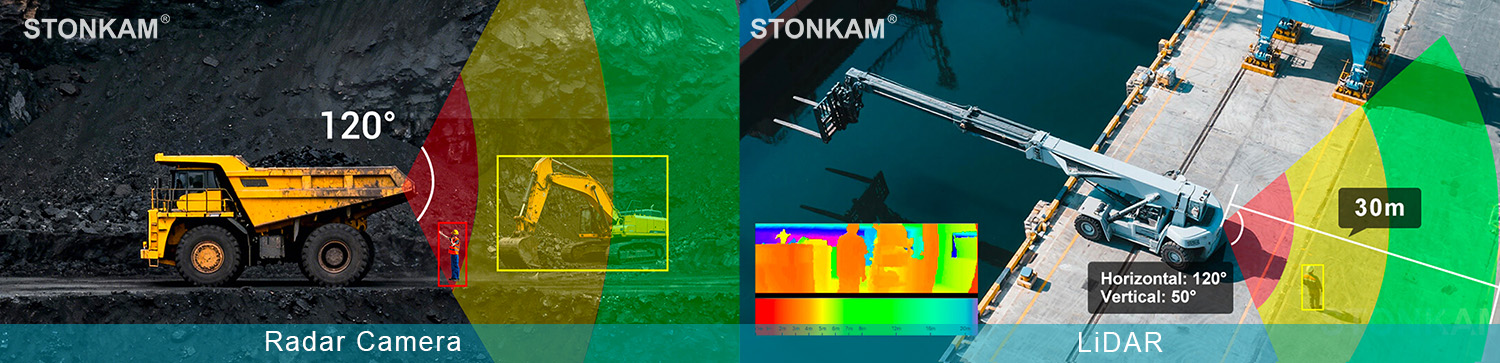
● Radar Camera
Combines 77GHz Millimeter Wave Radar with visual systems to achieve all-weather, multi-dimensional perception. Maintains high reliability in low-light and obstructed environments, ideal for mining trucks, forklifts, and commercial vehicles.
● LiDAR
Provides high-precision distance measurement and 3D detection, suitable for blind-spot compensation, obstacle avoidance, and positioning in ports and automated systems.
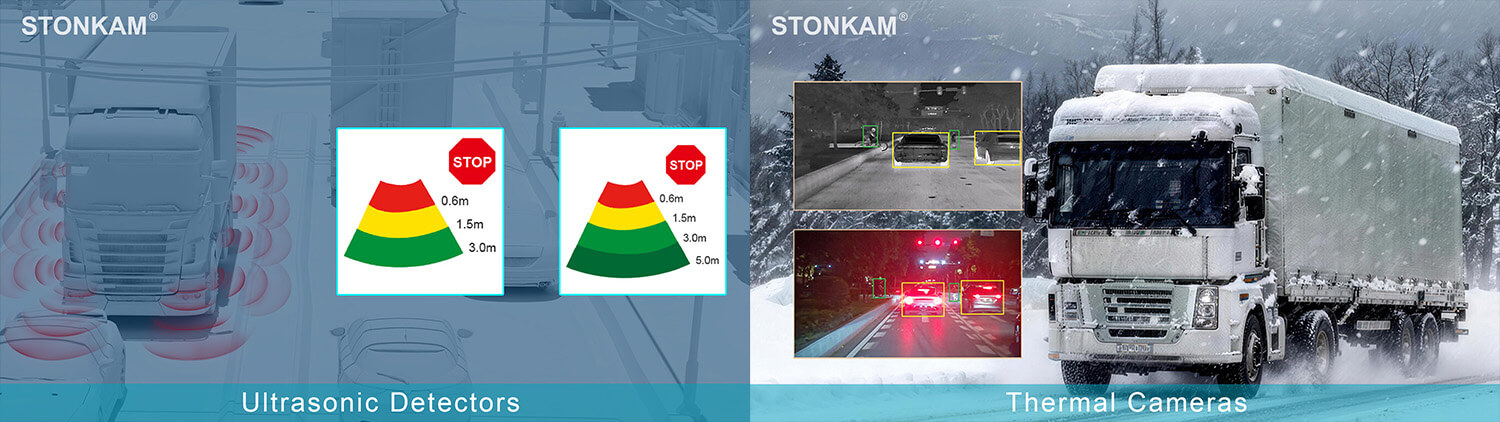
● Thermal Cameras
Integrate thermal imaging with visible light, supporting AI-based pedestrian and vehicle detection. Perform reliably in dust, fog, low light, and glare conditions.
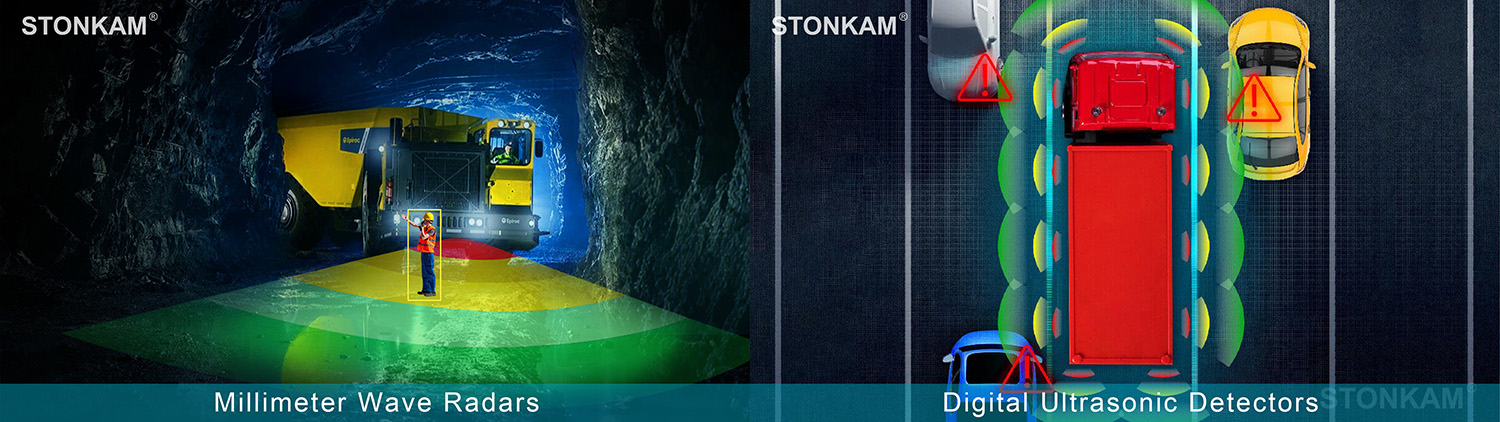
● Millimeter Wave Radars
Enable short-to-medium range detection with strong anti-interference capability, providing timely alerts for hazard avoidance.
● Ultrasonic Detectors
Designed for short-range detection, ideal for low-speed maneuvering and confined-space obstacle avoidance.
By integrating Non-visual AI Perception, STONKAM enhances system value across key scenarios:
● Mining & construction: Reduces risks caused by dust and complex environments
● Logistics & transportation: Improves safety in night and adverse weather conditions
● Ports & heavy equipment: Enhances multi-directional perception and reduces blind spots
● Public transportation: Improves detection of pedestrians and non-motorized vehicles
This not only strengthens safety management but also supports cost reduction and operational efficiency.
As in-vehicle intelligence continues to evolve, Non-visual AI Perception is shifting from a supporting role to a core capability. With advancements in algorithms and edge computing, multi-sensor fusion will deepen further, driving higher levels of system intelligence.
In this process, Non-visual AI Perception and Visual AI Perception will continue to evolve together, forming a truly comprehensive, all-scenario safety system.
Q1: What is a Non-visual AI Perception camera?
It refers to a sensing approach using devices such as Radar Cameras, LiDAR, Thermal Cameras, and Ultrasonic Detectors. Instead of image recognition, it relies on data like distance, speed, and signal reflection for detection.
Q2: Why is Non-visual AI Perception needed?
Visual AI Perception is affected by lighting and environment, while Non-visual AI Perception operates independently of these factors, ensuring stable performance in all-weather conditions.
Q3: What problems does STONKAM Non-visual AI Perception solve?
It addresses visibility and stability issues in complex environments by providing reliable detection, precise measurements, and reducing false or missed alerts.
Q4: What devices are included in STONKAM Non-visual AI Perception solutions?
Solutions typically include Radar Cameras, LiDAR, Thermal Cameras, Ultrasonic Detectors, and Radar-Vision Integrated Units, configurable for different needs.
Q5: How to choose the right STONKAM Non-visual AI Perception solution?
Evaluate based on application scenarios, environmental conditions, and functional requirements, while considering compatibility and scalability to balance performance, stability, and cost.
STONKAM CO., LTD
Add: 1/F.,#6Building,Huangzhou Industrial Park, Chebei Rd.,Tianhe,510660 Guangzhou,China
Tel: (86-20)6667 0988
Fax: (86-20)6667 0977
E-mail: sales@stonkam.com
WhatsApp: +86-15521270579; +86-15708917305

Copyright ©2002-2022 STONKAM CO.,LTD. 广州敏视数码科技有限公司 ALL Rights Reserved. 广东省通信管理局 粤ICP备05043268号





 AI intelligent systems
  AIoT
AIoT  360° Vision Systems
  Intelligent Terminal
  HD Monitors
  AHD Cameras
  Digital Cameras
  CMS
CMS  AI Wireless
  Regulations
  Thermal Cameras
  OEM Solutions
  Industry Applications
 Successful Case
  News
News
 Videos Center
 Introduction
  Why STONKAM®
  Culture
  Milestone
  Certificates
  Contact Us
 Support