
NEWS
2026-04-28
With the deep integration of 5G communication, artificial intelligence, and Internet of Things (IoT) technologies, AIoT (Artificial Intelligence of Things) is rapidly expanding beyond consumer electronics and passenger vehicles into broader non-passenger sectors such as commercial vehicles, construction machinery, and port equipment.
According to International Data Corporation (IDC), worldwide Internet of Things (IoT) spending is projected to surpass $1 trillion in 2026, driven by high demand for AI-enabled, secure, and interoperable solutions. The market is experiencing strong growth, with investments focusing heavily on industrial, manufacturing, and AI-centric applications as part of digital transformation initiatives.
Meanwhile, according to MarketsandMarkets, expanding IoT deployments in industrial and smart city applications, along with advances in low-power and high-performance computing, are driving demand for IoT hardware such as sensors and processors. The report also notes that smart manufacturing is anticipated to lead the IoT market, due to its ability to optimize production, reduce downtime, and enhance efficiency through real-time data and automation.
Within the commercial vehicle sector, buses and logistics trucks are key to urban and intercity transport, with high usage frequency and strict safety requirements making them ideal for AIoT deployment. This trend is also expanding to construction machinery and port equipment. Driven by digital transformation, industries are leveraging 5G, big data, cloud computing, and AI to enable smarter fleet coordination, connected worksites, and automated operations.
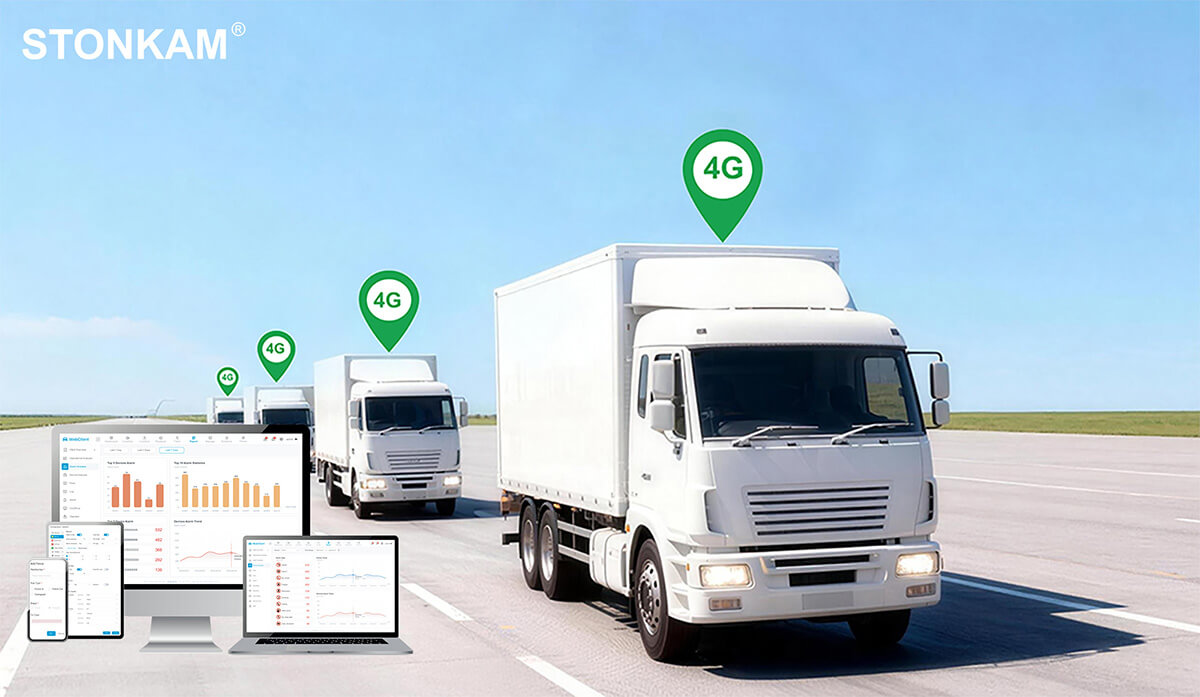
Against this backdrop, STONKAM has built a comprehensive product ecosystem centered on “AIoT” enabling seamless integration of vehicles, personnel, and platforms to unlock data value. As a key pillar within its three core product systems, STONKAM AIoT products act as the “central hub” within the overall architecture. Combined with AI Perception Device and AI Human Machine Interface, they deliver advanced capabilities in vehicle monitoring, fleet operations, and risk management.
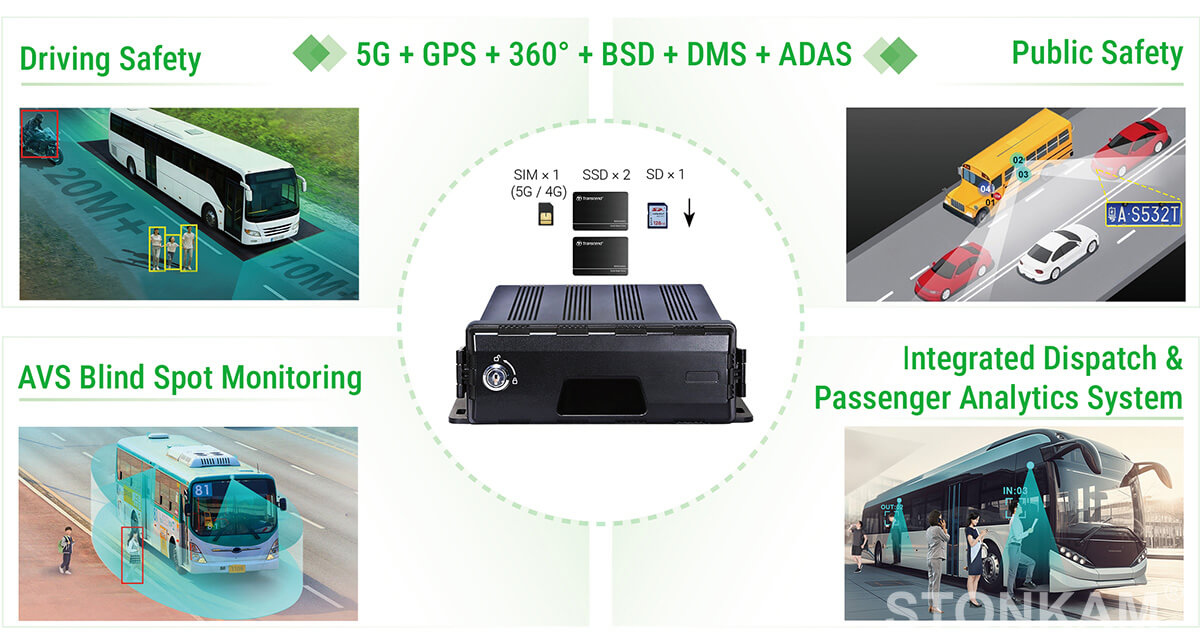
Within the intelligent connectivity architecture, in-vehicle devices serve as critical nodes for data processing and transmission. Powered by cellular/Wi-Fi, the STONKAM AI MDVR enables remote video monitoring and centralized cloud management for real-time fleetvisualization.
Built on a unified hardware platform and software-defined architecture, it integrates 5G communication, GPS positioning, 360° AVS, BSD, DMS, and ADAS, forming a powerful in-vehicle “central control unit.”
In real-world applications, the STONKAM AI MDVR not only enhances driving and public safety but also extends to passenger services and operational management. By enabling standardized data and resource sharing, it significantly reduces system deployment and maintenance costs.
For example, in bus and public transit scenarios, integration with dispatching systems and passenger flow analytics allows operators to monitor vehicle status and ridership changes in real time, optimizing routes and scheduling.
Additionally, the system supports encrypted video, electronic checklists, and RFID management technologies to enhance data security and operational efficiency. Open API interfaces enable seamless integration and data sharing, providing strong support for digital transformation and the evolution toward AI-driven fleet management systems.
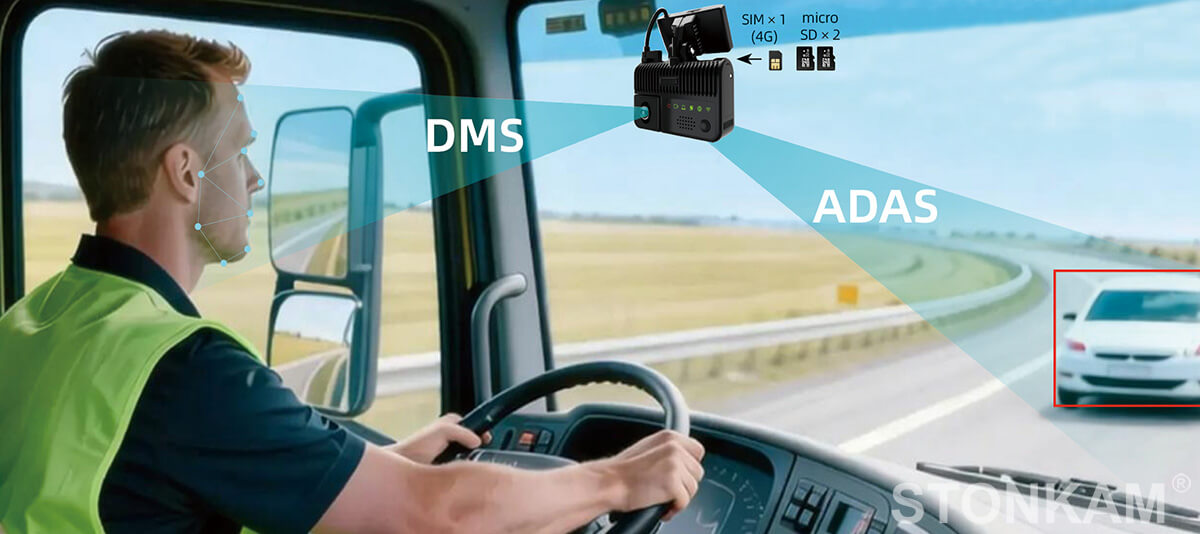
Compared to system-level MDVR deployment, the STONKAM AI Dashcam provides a more lightweight and flexible path to intelligent vehicle upgrades. It features built-in DMS and ADAS dual AI algorithms and supports expansion with up to two additional cameras, maintaining core active safety functions while ensuring ease of installation.
From a technical perspective, the AI Dashcam supports data acquisition via OBD (CAN bus), capturing vehicle speed, engine RPM, GPS location, and overall vehicle status. This provides a solid data foundation for driver behavior analysis and vehicle health management.
Its low-power “Sentry Mode” and “Remote Wake-up Function” allow continuous monitoring even when the vehicle is turned off. Operators can remotely check vehicle surroundings at any time. When human presence is detected, the system automatically increases recording frame rates to capture critical evidence—effectively mitigating risks such as cargo or fuel theft.
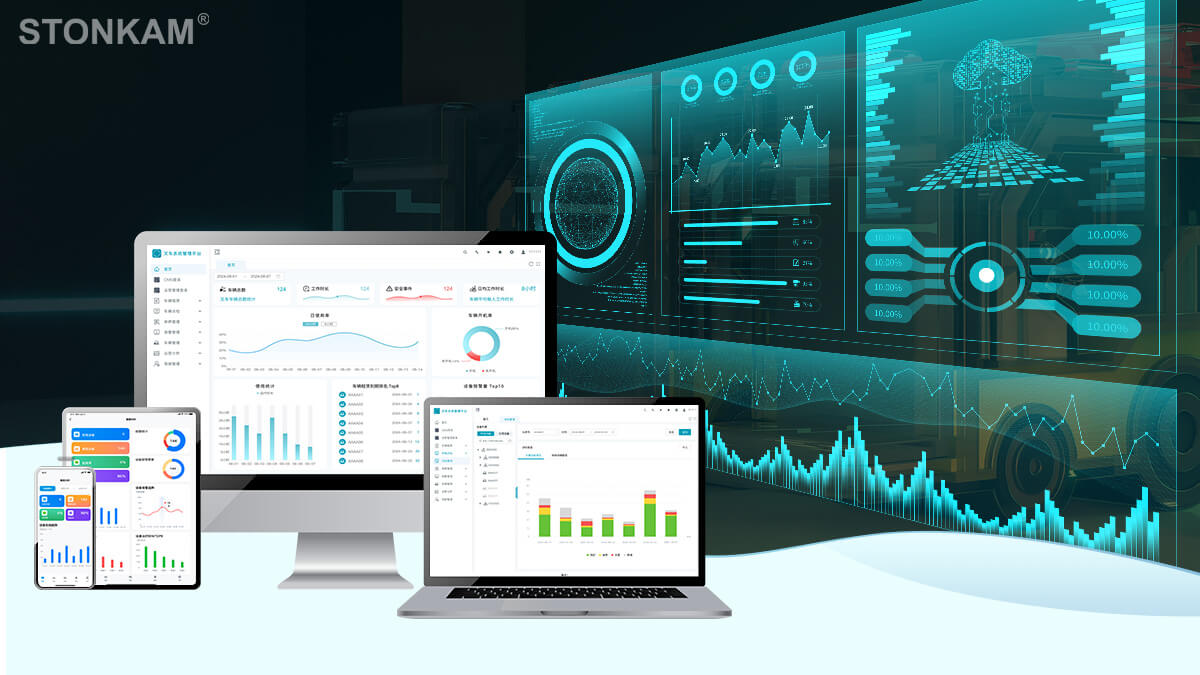
While intelligent perception devices handle environmental sensing and smart cockpit systems enable human-machine interaction, intelligent connectivity devices are responsible for data acquisition. However, unlocking the full value of this data relies on cloud platform collaboration.
The STONKAM AI Fleet Management Platform leverages big data analytics and visualization technologies to provide real-time statistical data and visual analysis of vehicle alarm events, enabling intuitive trend analysis. It can help managers gain a comprehensive understanding offleet operation status, quickly identify involved vehiclesand drivers, reduce accident rates, and effectivelyprotect high-value assets.
● Operational Visualization: Data dashboards provide a clear overview of fleet operations, automatically generating trip reports to help managers quickly identify key information and pinpoint involved vehicles and drivers.
● Risk Management: When dangerous driving behavior is detected, the system automatically sends alerts to managers and provides instant access to cloud-based video footage, supporting incident investigation and driver liability protection.
● Safety & Compliance Support: Built-in G-sensor detection accurately identifies harsh acceleration, braking, and cornering. Combined with regulation-compliant AI BSD algorithms, the system supports multi-level alerts and flexible deployment, meeting blind spot safety requirements in commercial vehicle operations.
In addition, the platform supports integration with mainstream telematics platforms such as CMSV6 and Wialon, as well as self-deplayed platform, ensuring seamless compatibility with existing fleet management infrastructures.
From vehicle-side perception to cockpit interaction, and from cloud collaboration to data-driven decision-making, STONKAM delivers a fully integrated ecosystem combining AI Perception Device, AI Human Machine Interface and AIoT. This creates a closed-loop architecture of “vehicle sensing – driver interaction – cloud data connectivity,” enabling not only real-time vehicle and equipment monitoring but also extending data value to operational decision-making.
Looking ahead, as AIoT technologies continue to evolve and industry standards further mature, AIoT will unlock greater value across a wider range of vehicle applications—becoming a key driver of industry transformation. Technology providers like STONKAM will continue to innovate with more open architectures and comprehensive product ecosystems, supporting the industry’s transition toward safer, more efficient, and sustainable intelligent operations.
STONKAM CO., LTD
Add: 1/F.,#6Building,Huangzhou Industrial Park, Chebei Rd.,Tianhe,510660 Guangzhou,China
Tel: (86-20)6667 0988
Fax: (86-20)6667 0977
E-mail: sales@stonkam.com
WhatsApp: +86-15521270579; +86-15708917305
Copyright ©2002-2022 STONKAM CO.,LTD. 广州敏视数码科技有限公司 ALL Rights Reserved. 广东省通信管理局 粤ICP备05043268号




 AI intelligent systems
  AIoT
AIoT  360° Vision Systems
  Intelligent Terminal
  HD Monitors
  AHD Cameras
  Digital Cameras
  CMS
CMS  AI Wireless
  Regulations
  Thermal Cameras
  OEM Solutions
  Industry Applications
 Successful Case
  News
News
 Videos Center
 Introduction
  Why STONKAM®
  Culture
  Milestone
  Certificates
  Contact Us
 Support