STONKAM Forklift AI Collision Warning System: Blind Spot Detection & Ground Warning Lights
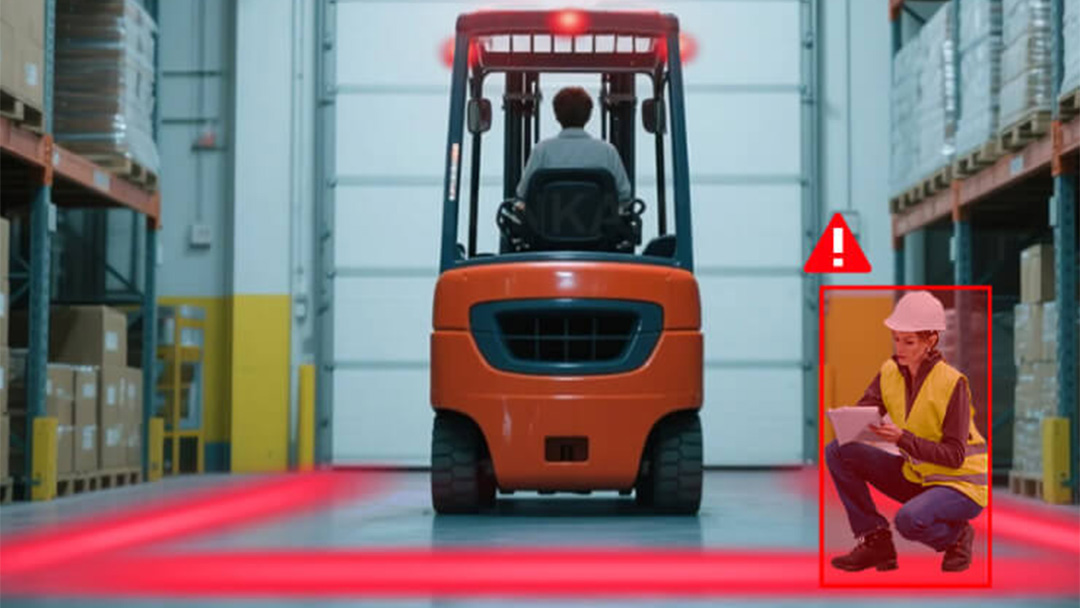
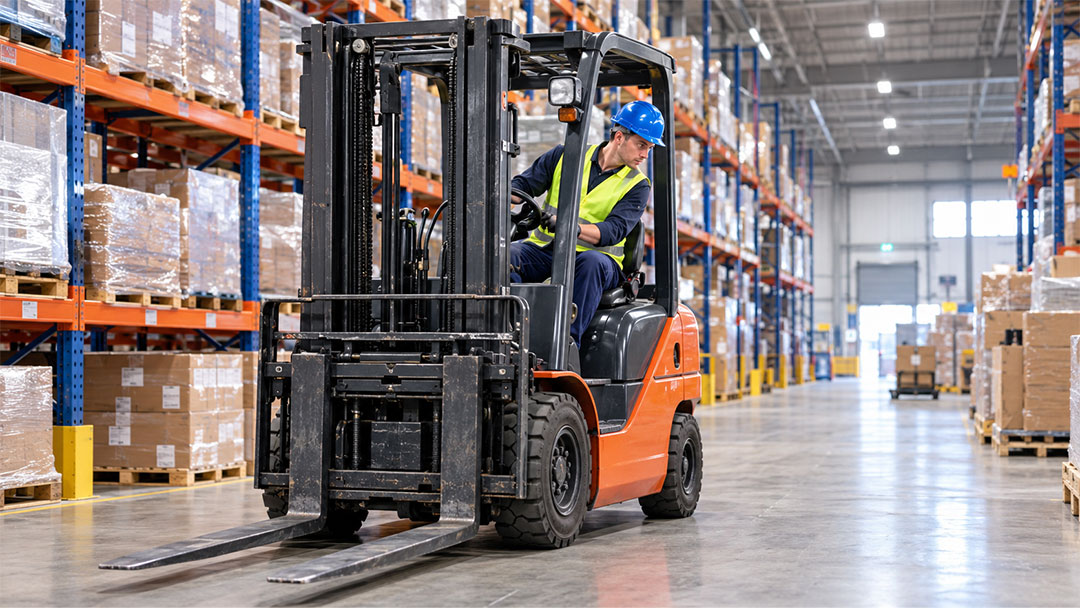
In warehouses, manufacturing plants, and logistics facilities, forklifts frequently operate around pedestrians, storage racks, and other vehicles. Loads, vehicle structures, and narrow aisles can limit driver visibility, especially when turning, reversing, or crossing busy areas, increasing the risk of collisions.
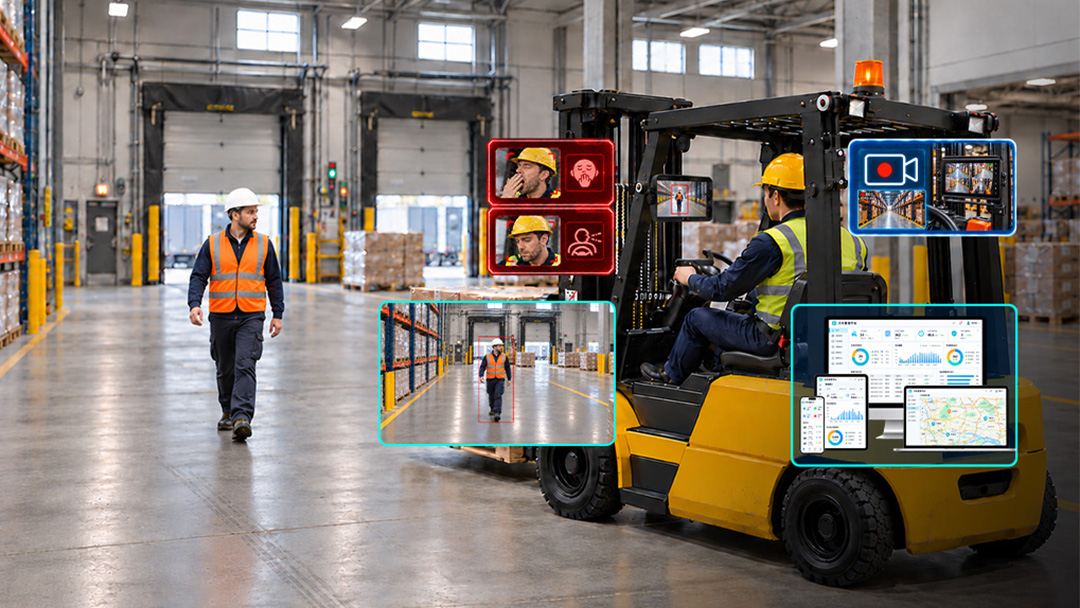
STONKAM forklift AI collision warning system addresses these risks through AI pedestrian and vehicle detection, blind spot monitoring, and audible and visual alerts. It also supports video recording, while optional three‑sided ground warning lights provide additional visual warnings for nearby workers.
What Are the Key Components of a Forklift AI Collision Warning System, and How Does It Work?
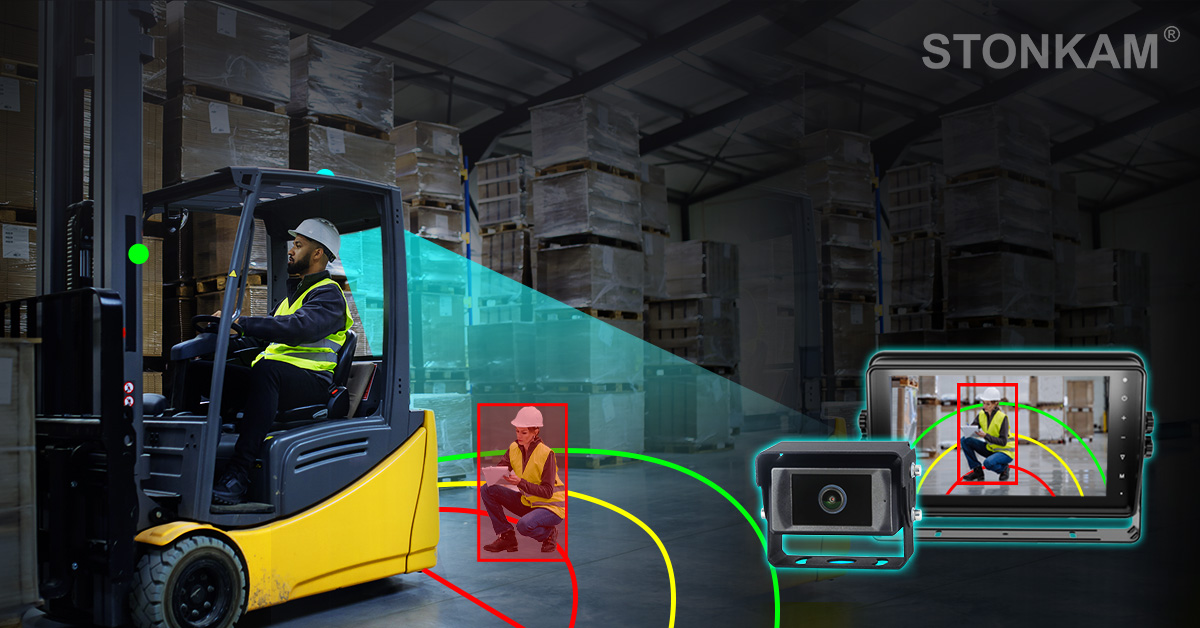
STONKAM forklift AI collision warning system combines AI blind spot monitoring cameras, an in‑vehicle recording monitor, and external audible and visual alarm devices. Together, these components detect pedestrians and vehicles around the forklift and provide timely risk alerts.
How the system works:
Surrounding video capture → AI pedestrian and vehicle detection → Warning zone assessment → In‑cab and external alerts → Event video recording
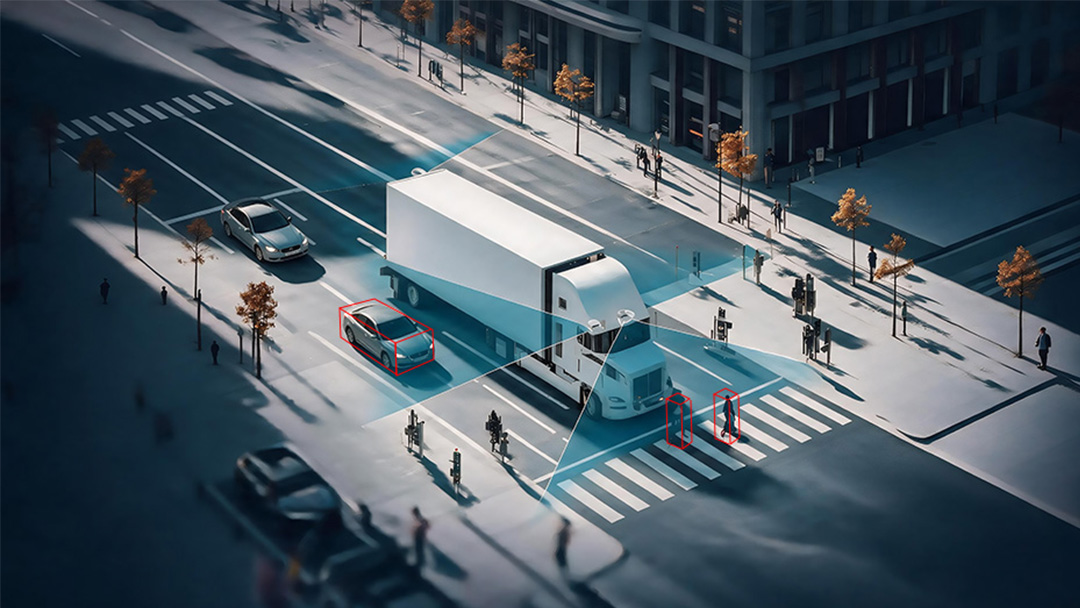
AI cameras continuously capture the area around the forklift and use deep learning algorithms. The AI forklift pedestrian detection helps to identify pedestrians and vehicles. The system assesses target positions against preset warning zones and alarm conditions.
When a target enters a designated warning zone and meets the alarm conditions, the monitor displays detection footage and warning information, while the external alarm device provides audible and visual alerts according to the system configuration. Relevant video footage can also be recorded for later review.
Optional three‑sided ground warning lights project visible lines onto the ground, helping nearby workers identify the forklift's operating boundaries.
How Does AI Detection Improve Forklift Pedestrian and Blind Spot Safety?
● AI Pedestrian and Vehicle Detection
STONKAM AI cameras use deep learning to detect pedestrians and vehicles, displaying tracking boxes and warning indicators. AI‑based detection helps operators drivers identify potential hazards around obstructed loads and warehouse intersections.
● Warning Zone Assessment and Active Alerts
The system triggers alerts when detected targets enter preset warning zones and meet alarm conditions. The in‑cab monitor displays warning information with visual and audible alerts, while external alarm devices can warn nearby workers and vehicles through audible and visual signals, providing a proximity alert warning.
● Multi‑Directional Forklift Blind Spot Monitoring
Multiple AI cameras monitor key blind spots at the front sides, sides, and rear. Each camera offers up to 130° horizontal viewing angle and a detection range of up to 20 meters, extending forklift blind spot detection beyond direct observation and mirrors.
● Video Recording and Industrial Protection
The system supports loop and event‑triggered recording. The IP66 monitor, IP69K cameras, and vibration‑resistant design suit demanding forklift environments with dust, moisture, and vibration.
How Do Three‑Sided Ground Warning Lights Complement STONKAM's AI Blind Spot Detection System?
STONKAM's three‑sided ground warning lights are an optional addition to its Forklift AI Collision Warning System. Installed on both sides and at the rear of the forklift, they project visible warning lines onto the ground, helping nearby workers recognize the vehicle's operating boundaries.
AI cameras remain responsible for detecting pedestrians and vehicles, assessing warning zones, and triggering alerts when configured alarm conditions are met.
For supported configurations, the system can also recognize projected warning light patterns and use them to assist with automatic detection zone calibration. The visible ground boundaries and AI detection zones should be configured according to the actual installation and operating requirements.
Customers can choose the AI blind spot detection system independently or combine it with three‑sided ground warning lights when additional visual warnings are required.
AI Camera vs. Radar vs. Standard Cameras: Which Forklift Safety System Fits Your Operation?
|
Comparison |
Radar‑Based Warning |
Standard Video Monitoring |
|
|
Detection |
Detects target distance and relative speed, depending on sensor type |
Captures surrounding images for driver observation |
AI cameras detect pedestrians and vehicles |
|
Target Recognition |
Mainly detects obstacles; classification depends on sensor and algorithm |
No AI‑based target recognition |
Displays pedestrian and vehicle tracking boxes |
|
Risk Assessment & Alerts |
Triggers alarms based on distance, speed, or preset thresholds |
Relies on driver observation |
Triggers in‑cab alerts and, depending on configuration, external alarms based on preset warning zones |
|
Video Recording |
Usually requires additional video equipment |
Depends on camera and recording configuration |
Supports loop and event‑triggered recording when paired with a compatible recording monitor |
Radar‑based systems provide distance and motion‑related information, while conventional camera systems help drivers observe surrounding areas. STONKAM AI Blind Spot Detection System adds pedestrian and vehicle recognition, predefined warning zone assessment, and configurable audible and visual alerts. These capabilities help forklift operators respond to detected risks without relying solely on continuous visual observation.
Where Can Forklift AI Collision Warning Systems Improve Workplace Safety?
Warehouse aisles and intersections: Side or front‑side AI cameras detect pedestrians and vehicles entering monitored areas as forklifts turn or exit rack aisles.
Loading and material transfer areas: Rear monitoring, on‑screen alerts, and optional external alarms help drivers and nearby workers respond to potential hazards caused by obstructed loads and reversing.
Manufacturing plants and logistics centers: Camera positions and alarm configurations can be adapted to vehicle structure, blind spots, and pedestrian routes, with optional ground warning boundaries.
STONKAM supports both existing forklift upgrades and OEM integration projects. AI camera positions, warning zones, recording functions, and external alarm devices can be configured according to forklift models, vehicle structures, and monitoring requirements.
For applications requiring additional ground‑level visual warnings, three‑sided warning lights can also be incorporated into the system. STONKAM provides configuration and integration support for forklift manufacturers, system integrators, and fleet operators.
Forklift AI Safety: STONKAM Project Experience
In a European forklift safety integration project, a partner purchased approximately 20,000 sets of STONKAM AI forklift collision warning systems. The solution combines AI pedestrian detection, blind spot monitoring, and optional video recording for warehouse, manufacturing, and logistics applications.
Conclusion
STONKAM forklift AI collision warning system combines AI target recognition, blind spot monitoring, warning zone assessment, in‑cab and external alerts, and optional video recording. three‑sided ground warning lights can also be added to provide visible ground boundaries. Configurations can be adapted to different forklift models and operating requirements for manufacturers, system integrators, and fleet operators.
-
STONKAM's AI cameras detect pedestrians and vehicles within configured monitoring areas. When detected targets enter predefined warning zones and meet the alarm conditions, the system provides alerts to help operators identify potential collision risks.
-
No. STONKAM's AI blind spot detection system can operate without ground warning lights. Optional three-sided lights provide visible ground boundaries, while supported configurations can use projected light patterns to assist with detection zone calibration.
-
STONKAM supports horizontal detection ranges of 0.5–30 m for front and side views, and 0.5–20 m for rear views, depending on camera installation and configuration.
-
The system provides visual target tracking and warning information through a compatible in-cab monitor. External audible and visual alarms are also available through supported camera configurations or connected alarm devices.
-
Yes. When equipped with a compatible recording monitor, the system supports loop recording and event-triggered video recording. Storage capacity depends on the selected equipment and memory configuration.
-
Yes. STONKAM supports retrofit and OEM projects with configurable AI cameras, monitors, and alarm devices. Installation can be adapted to forklift structures, mounting spaces, power supplies, and required monitoring areas.