Emergency Vehicle Monitoring System for Ambulances & Fire Trucks
Why Do Emergency Vehicles Need More Than a Standard Dash Cam?
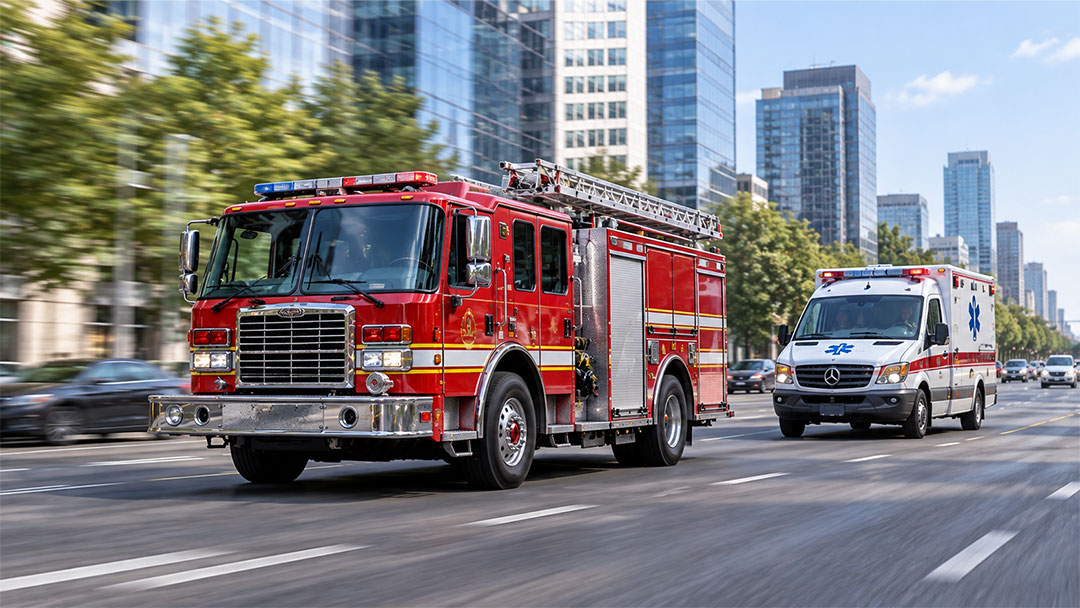
Emergency vehicles operate in time‑critical and unpredictable environments, where a standard front‑facing dash cam may not provide sufficient visibility or video coverage for emergency driving, manoeuvring, and incident review.
● Limited Surrounding Visibility: Large vehicle dimensions, blind spots, and frequent turning or reversing make it difficult to observe surrounding vehicles, obstacles, and personnel.
● Insufficient Video Coverage: A single front‑facing camera cannot capture important events occurring around the sides, rear, or inside the vehicle.
● Difficult Incident Investigation: Limited viewing angles can make it harder to reconstruct driving events and understand what happened during emergency operations.
● Limited Fleet Visibility: Managing vehicles operating across different locations makes centralized vehicle monitoring and video access increasingly important.
How Does the STONKAM Emergency Vehicle Monitoring System Work?
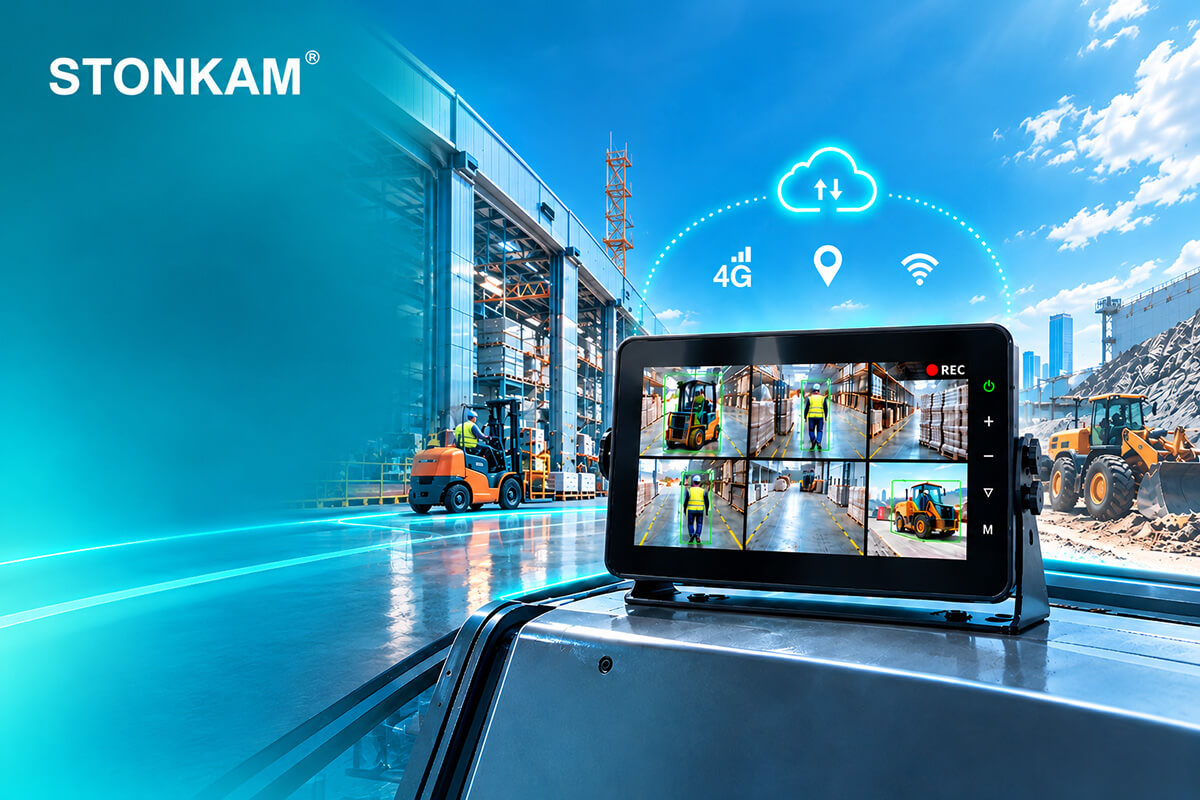
STONKAM provides a configurable emergency vehicle monitoring system that combines multi‑channel HD cameras, AI‑enabled Mobile Digital Video Recorders (MDVRs), optional driver assistance functions, and remote fleet management capabilities.
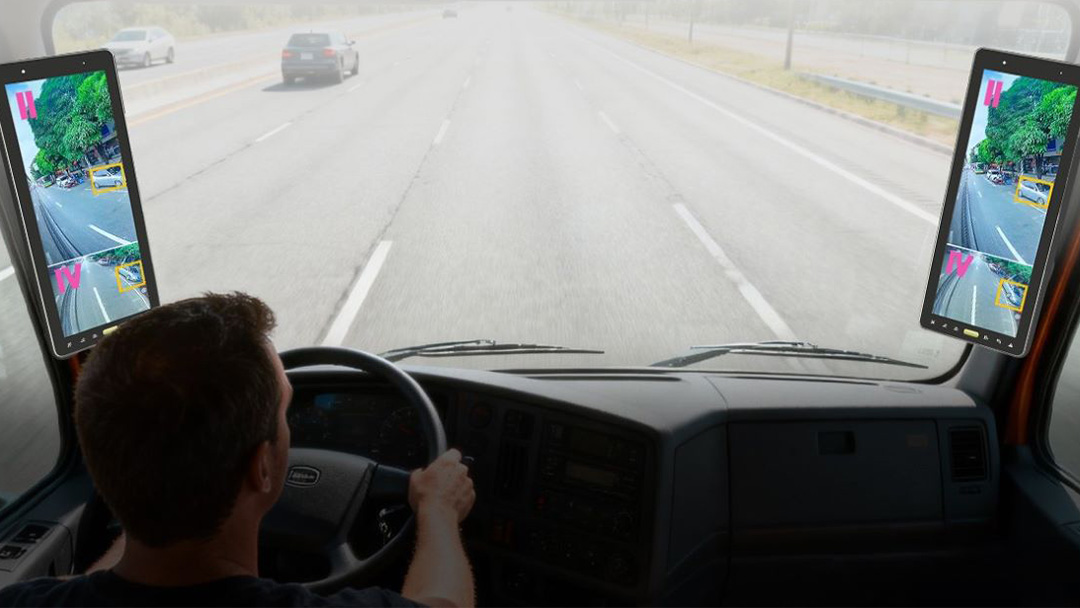
Camera types, quantities, and mounting positions can be tailored to the vehicle structure and monitoring requirements of ambulances, fire trucks, and other emergency vehicles. The system supports multi‑angle video monitoring and centralized recording, helping operators observe vehicle surroundings and retrieve footage for incident review.
With compatible 4G connectivity, GPS positioning, and fleet management platforms, the solution can also support remote live viewing, video playback, vehicle tracking, and centralized fleet monitoring.
How Does Camera Configuration Differ Between Ambulances and Fire Trucks?
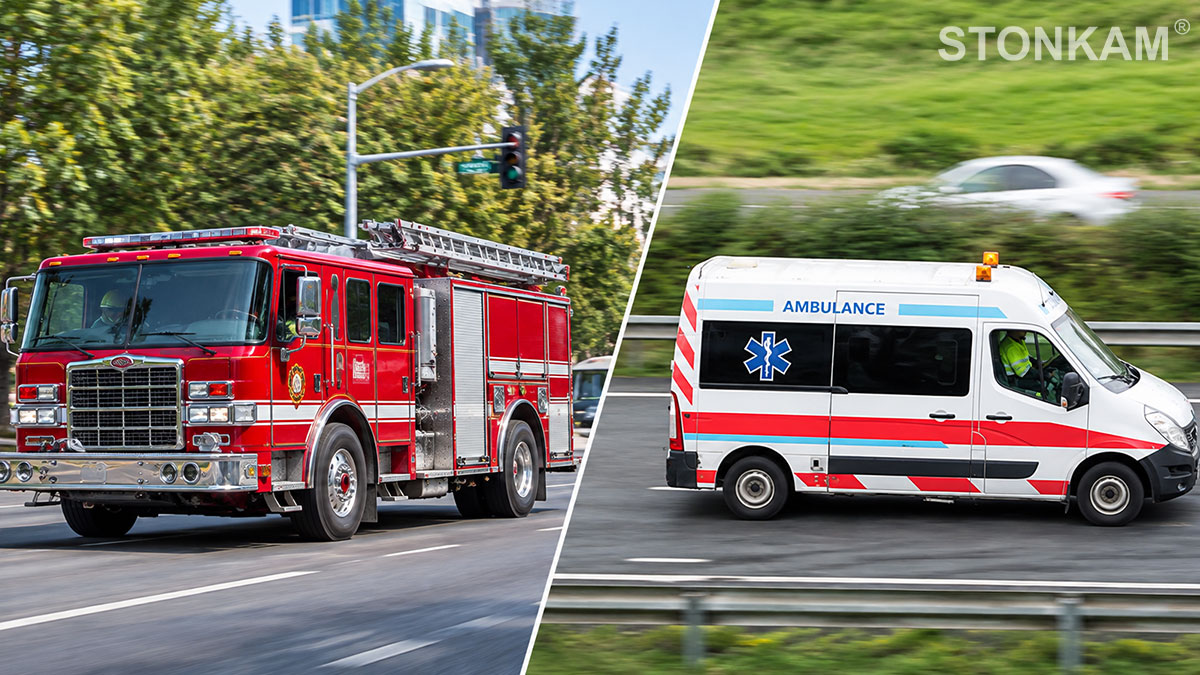
Ambulances and fire trucks have different monitoring priorities due to their vehicle structures and operational scenarios. Camera configurations can be adapted as follows:
1. Fire Truck Camera System: Visibility Around Large Emergency Vehicles
● Blind Spot Monitoring: Front, side, and rear cameras provide additional views of areas that are difficult for drivers to observe directly.
● Turning, Reversing and Station Manoeuvring: Side and rear camera views help drivers assess surrounding vehicles, pedestrians, and obstacles when turning, reversing into fire stations, or positioning vehicles at emergency scenes.
● Emergency Scene Observation: Multiple camera views help drivers monitor surrounding conditions when positioning fire trucks at accident sites or crowded emergency scenes.
2. Ambulance Camera System:Driving Visibility and Video Documentation
● Road Monitoring: Front‑facing cameras record road conditions and surrounding traffic during emergency transport.
● Reversing and Parking: Rear and side cameras help drivers observe nearby obstacles when reversing or parking near hospitals and incident locations.
● Optional In‑Cabin Monitoring: Where permitted by applicable privacy requirements and operational policies, interior cameras can be configured to record designated areas inside the ambulance for authorized incident review and operational documentation.
● Video Recording: Interior and exterior camera feeds can be connected to an MDVR system for centralized recording and footage retrieval.
● Key Difference: Fire truck camera systems prioritize large‑vehicle blind spots and emergency scene visibility, while ambulance camera systems focus on road monitoring, parking assistance, and in‑cabin video recording.
To address these different monitoring needs, STONKAM provides flexible multi‑camera configurations and integrated monitoring solutions tailored to ambulance and fire truck applications.
How Can Optional AI Safety Features Support Emergency Vehicle Drivers?
Fire trucks and rescue vehicles often manoeuvre in congested roads and complex emergency scenes, while ambulances face risks during emergency transport and parking. NHTSA reports that 45.7% of fatal ambulance crashes occurred during emergency use.USFA also highlights the blind spot risks of large fire and emergency vehicles, particularly during backing and turning manoeuvres in demanding emergency scenarios.
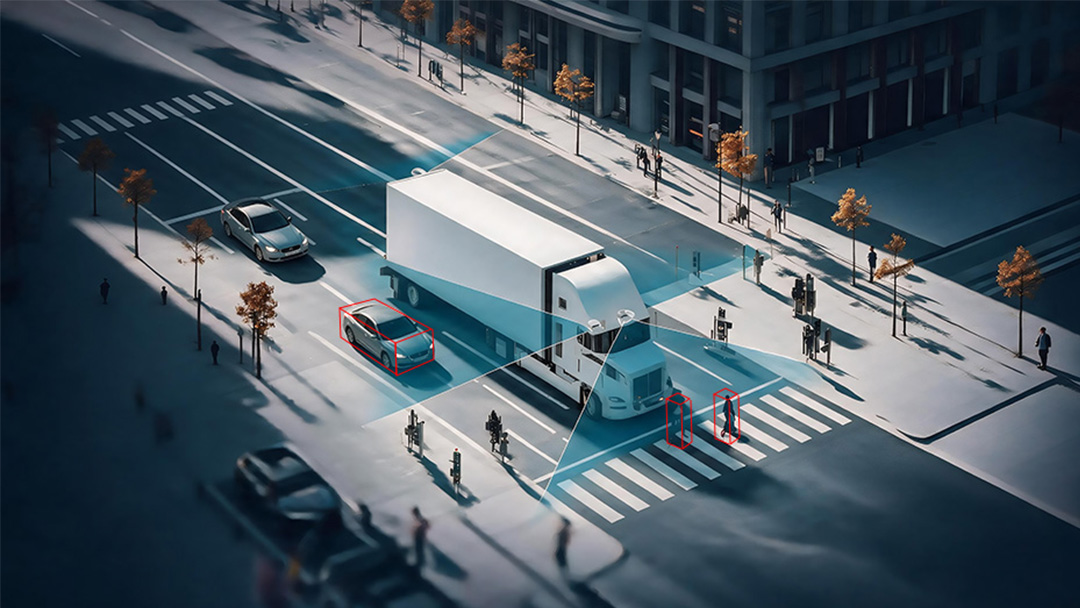
Depending on vehicle requirements and system configuration, STONKAM's AI MDVR solutions can integrate optional ADAS, DMS, BSD, and 360° AVM functions. Supported algorithm combinations can operate simultaneously to provide driver alerts, surrounding visibility assistance, and event recording.
● Forward Collision Warning (FCW): Alerts drivers to potential forward collision risks with vehicles ahead, supporting earlier hazard awareness during emergency driving.
● Blind Spot Detection (BSD): Detects nearby vehicles and pedestrians when fire trucks turn through narrow streets or manoeuvre around crowded accident scenes.
● Driver Status Monitoring (DMS): Identifies fatigue and distraction during long emergency shifts and continuous driving.
● 360° Around View Monitoring (AVM): Combines compatible camera views to provide a bird's‑eye perspective around the vehicle, assisting with low‑speed manoeuvring, reversing, and positioning in confined spaces.
By combining these optional AI functions with real‑time alerts and video recording, STONKAM helps emergency vehicle drivers improve hazard awareness, reduce blind spot risks, and make safer manoeuvring decisions across different response scenarios.
How Does STONKAM Support Incident Video Recording and Secure Evidence Management?
During emergency response, video records can help clarify road incidents, document rescue operations, and support subsequent investigations. STONKAM AI MDVR system connects multiple HD cameras to capture and centrally store footage from different views, providing essential video records for incident review, evidence collection, and operational assessment.
● In‑Cabin and Exterior Video Recording: Records vehicle journeys, activities inside the ambulance or rescue vehicle, and surrounding emergency operations through multiple HD cameras.
● Centralized MDVR Recording and Storage: Records and stores multi‑channel video footage centrally, allowing fleet managers to review driving incidents and emergency operations.
● Incident Footage Retrieval: Supports remote live viewing, video playback, and event footage export, reducing the need to retrieve recording devices manually.
● Encrypted Storage and Access Management: Uses data encryption and access permissions to help protect sensitive footage involving patients, emergency personnel, and rescue operations.
By combining multi‑channel recording, remote video access, and data protection, STONKAM helps emergency service fleets maintain video records for incident investigation and operational traceability.
How Does STONKAM Support Remote Monitoring and Fleet Management for Emergency Vehicles?
Managing emergency vehicles across different locations requires remote access to vehicle status and onboard video. STONKAM AI MDVR system supports integration with customer platforms, enabling centralized remote monitoring and video management.
● GPS Tracking and Fleet Operations: Provides real‑time vehicle positioning, historical route tracking, and electronic fence functions, helping fleet operators monitor vehicle movements and review travel records.
● Vehicle Status and Event Reporting: Supports uploading dangerous driving events and vehicle abnormalities to the fleet platform, making it easier to identify operational issues and follow up on reported events.
● Fleet Platform Integration: STONKAM AI MDVR solutions support connectivity with compatible platforms such as CMSV6 and Wialon, as well as integration through the JT/T 808 protocol and APIs. Depending on the project configuration, fleet operators can access vehicle location data, video feeds, event information, and recorded footage through supported management interfaces.
By connecting onboard video, GPS tracking, and customer platforms, STONKAM helps emergency service fleets centralize video resources and improve remote operational visibility.
Real‑World Application: STONKAM AI MDVR System for an Australian Ambulance Fleet
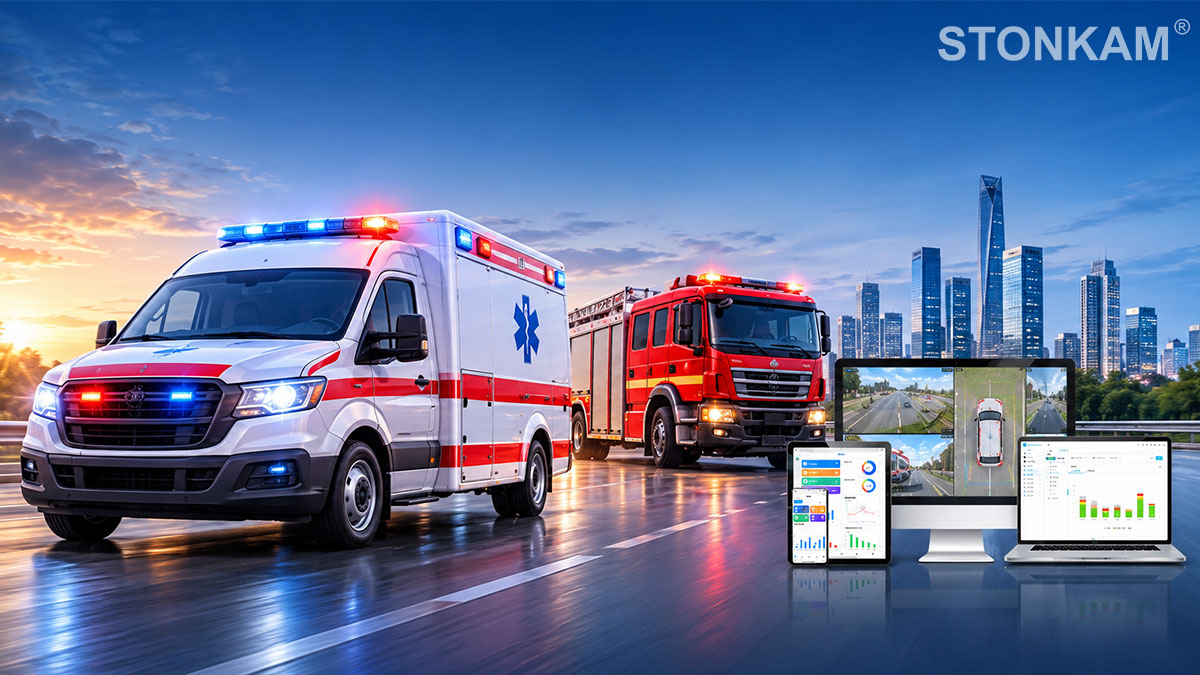
STONKAM deployed 1,000 AI MDVR systems for an Australian ambulance fleet, integrating the systems with the customer's existing platform to enable HD video monitoring, remote video access, and centralized fleet management.
This project demonstrates STONKAM's experience in large‑scale ambulance monitoring deployments, combining multi‑channel video recording, remote evidence retrieval, and customized platform integration to support emergency fleet operations.
Why Choose STONKAM for Emergency Vehicle Monitoring Solutions?
STONKAM Emergency Vehicle Monitoring Solutions are designed to meet the different monitoring and operational requirements of ambulances, fire trucks, and rescue vehicles, with flexible configurations, reliable vehicle‑grade products, and integration support for fleet operations.
● Configurable Multi‑Camera and AI MDVR Solutions: Flexible camera layouts and AI function combinations for ambulances, fire trucks, and rescue vehicles.
● Vehicle‑Grade Product Development and Manufacturing: In‑house R&D and manufacturing capabilities for vehicle monitoring products designed for demanding operating environments.
● Flexible API and Platform Integration: Supports standard protocols, API connectivity, and customized development to connect with existing fleet management systems.
● Experience in Large‑Scale Fleet Projects: STONKAM has experience supporting large‑scale emergency vehicle deployments, including an Australian ambulance fleet project involving 1,000 AI MDVR systems integrated with the customer's existing management platform.
These capabilities enable STONKAM to deliver adaptable monitoring solutions for emergency vehicle manufacturers, fleet operators, and system integrators.
-
STONKAM offers configurable ambulance camera systems combining multi-channel HD cameras, AI MDVR recording, and optional remote fleet management. Camera positions and functions can be selected according to driving visibility, incident documentation, privacy requirements, and platform integration needs.
-
STONKAM fire truck camera systems can provide front, side, and rear views to assist drivers during turning, reversing, and vehicle positioning. Optional BSD and 360° AVM functions can provide additional alerts or surrounding views, depending on the selected configuration.
-
Yes. Fleet operators can remotely view live video and playback historical recordings through a connected fleet management platform. STONKAM AI Mobile DVR ensures continuous video recording and stable data storage.
-
Yes. With compatible network connectivity and fleet management platforms, STONKAM MDVR solutions can support remote live viewing, recorded video playback, and incident footage retrieval. Access and export permissions can be configured according to project requirements.
-
STONKAM can support project-specific data protection requirements through system configuration and integration. In an Australian ambulance fleet project, the deployed solution included encrypted video storage and permission-based footage export to help protect sensitive recordings.
-
Yes. STONKAM AI MDVR solutions support CMSV6, Wialon, JT/T 808, and API-based integration, depending on the product configuration. OEMs and system integrators can discuss customized integration requirements with STONKAM.
-
OEMs should evaluate camera coverage, recording channels, storage capacity, optional AI functions, network connectivity, data security, and fleet platform compatibility. STONKAM provides configurable camera and AI MDVR solutions with engineering support for ambulance and fire truck monitoring applications.